
How to Choose a Reliable Cold Forging Manufacturer in India: 7-Point Checklist
Introduction
Cold forging has become one of the most efficient and reliable manufacturing processes for producing high-strength, precision-engineered metal components. As industries continue to demand lighter, stronger, and more cost-effective parts, cold forging has emerged as a preferred manufacturing method because of its excellent dimensional accuracy, superior mechanical properties, and high material utilization.
One of the biggest advantages of cold forging is its ability to produce near net shape components. Since the forged part is already very close to its final geometry, the amount of machining required is significantly reduced. This not only saves material and machining time but also improves productivity and lowers the overall manufacturing cost. In today’s competitive manufacturing environment, near net shape production has become a major advantage for OEMs looking to optimize both quality and efficiency.
India has evolved into one of the world’s leading manufacturing destinations, and companies searching for a Cold Forging Manufacturer in India have a wide range of options. However, selecting the right manufacturing partner should involve much more than comparing prices. The right supplier can improve product quality, ensure consistent deliveries, reduce supply chain risks, and contribute to long-term business success.
Whether the application is in automotive, construction, marine, aerospace, or other engineering sectors, choosing a reliable cold forging partner requires careful evaluation of technical capability, manufacturing infrastructure, quality systems, and customer support.
This seven-point checklist will help procurement teams, design engineers, and OEMs identify what truly matters when selecting a reliable Cold Forging Manufacturer in India and why manufacturers in Cold Forging Bangalore have earned a reputation for precision engineering.
1. Evaluate Manufacturing Experience
Experience is one of the strongest indicators of manufacturing reliability.
Cold forging is a specialized process that requires expertise in tooling, process control, material behavior, lubrication, and die design. Unlike simple machining operations, successful cold forging depends on years of accumulated knowledge and continuous process refinement.
An experienced manufacturer is generally better equipped to:
- Develop robust forging processes
- Optimize tooling life
- Improve dimensional consistency
- Minimize defects
- Solve production challenges efficiently
Manufacturers with long-term experience have also adapted to changing customer expectations and technological advancements.
At Accurate Bearing, we bring over two decades of experience in cold forging, allowing us to continuously improve our processes while delivering precision components for demanding industrial applications.
Experience does not simply reduce mistakes—it builds confidence that the manufacturer can consistently deliver quality over the long term.
2. Assess Manufacturing Capabilities and Infrastructure
Not all cold forging facilities have the same capabilities.
Before selecting a supplier, it is important to understand what sizes, weights, and geometries they can manufacture.
A reliable Cold Forging Manufacturer in India should have robust infrastructure capable of handling diverse customer requirements.
At Accurate Bearing, our forging facility includes:
- 250 Ton Knuckle Joint Presses
- 450 Ton Hydraulic Presses
These capabilities enable us to manufacture forged components up to:
- 60 mm diameter
- 500 grams in weight
The right equipment allows manufacturers to maintain process stability while achieving high production volumes with consistent quality.
Modern infrastructure also reflects a company’s commitment to investing in technology rather than relying on outdated manufacturing methods.
3. Understand the Complete Cold Forging Process
Many buyers evaluate only the final component and overlook the manufacturing process itself.
Understanding how a manufacturer controls each stage of production provides valuable insight into quality and consistency.
A typical cold forging process includes:
Material Procurement
The process begins with procurement of raw material based on customer specifications.
It is important to note that material selection is determined by the customer according to the application requirements. The manufacturer processes the specified material into the desired component.
In general, low and medium carbon steel grades are particularly suitable for cold forging because of their excellent formability and mechanical characteristics.
Shearing
Steel bars are cut into accurately sized blanks. Consistency at this stage directly affects the forging process.
Annealing
The blanks are annealed to improve ductility and facilitate deformation during forging.
Coating
The material is then coated using processes such as:
- Zinc phosphating
- Moly coating
These coatings reduce friction during forging and improve die life while ensuring smoother material flow.
Cold Forging
The prepared blanks are then forged into near net shape components under high pressure.
Because the material is shaped rather than removed, cold forging offers excellent material utilization and improved mechanical properties.
4. Look for In-House Secondary Processes
One of the biggest advantages of choosing the right manufacturer is the availability of integrated processes.
Many companies outsource critical operations such as annealing or coating, resulting in additional logistics, longer lead times, and greater process variation.
Having these facilities within the same manufacturing campus offers several advantages:
- Better process control
- Reduced transportation
- Faster production cycles
- Improved traceability
- Lower risk of damage during handling
At Accurate Bearing, both annealing and coating facilities are available in-house, enabling better coordination between manufacturing stages.
This integrated approach improves consistency while reducing dependence on external vendors.
5. Consider End-to-End Manufacturing Capability
Modern OEMs increasingly prefer suppliers capable of delivering complete manufacturing solutions.
Instead of sourcing forging, heat treatment, and machining from different vendors, many customers seek partners who can manage multiple processes under one roof.
An end-to-end solution offers benefits such as:
- Simplified supply chain management
- Better quality control
- Reduced lead time
- Improved accountability
- Greater manufacturing consistency
Beyond cold forging, Accurate Bearing also has:
- Heat treatment facilities
- Precision machining capabilities
This enables us to provide a more comprehensive manufacturing solution for customers requiring finished or semi-finished components.
Having multiple capabilities integrated into one organization improves coordination and enhances overall process reliability.
6. Evaluate Quality Systems and Continuous Improvement
Quality is not achieved through inspection alone—it is built into every manufacturing process.
A reliable Cold Forging Manufacturer in India should operate with structured quality management systems that emphasize prevention rather than correction.
When evaluating suppliers, consider whether they maintain internationally recognized certifications.
Accurate Bearing is certified to:
- IATF 16949
- ISO 9001
These certifications demonstrate a commitment to:
- Process discipline
- Continuous improvement
- Documentation
- Risk management
- Customer satisfaction
Quality systems create standardized procedures that improve consistency across high-volume production.
Rather than relying solely on final inspection, they encourage manufacturers to control variation throughout the manufacturing process.
This systematic approach helps reduce defects while improving long-term reliability.
7. Choose a Manufacturing Partner, Not Just a Vendor
Perhaps the most important factor is one that cannot easily be measured on a machine.
The best manufacturers become long-term partners rather than transactional suppliers.
A strong manufacturing partner should:
- Understand customer requirements
- Communicate transparently
- Respond quickly
- Support engineering improvements
- Focus on long-term relationships
Manufacturing challenges inevitably arise during product development and production. Companies that work collaboratively with customers are often able to solve problems more effectively.
At Accurate Bearing, our philosophy is simple: deliver more than what the customer expects.
Our team believes that technical capability must be complemented by responsiveness, accountability, and customer commitment.
Long-term relationships are built not merely through competitive pricing but through consistent performance and trust.
Why Near Net Shape Makes Cold Forging So Valuable
One of the defining advantages of cold forging is the ability to produce components that are very close to their final dimensions.
This near net shape capability offers several benefits:
- Reduced machining
- Lower material wastage
- Shorter production cycles
- Better dimensional consistency
- Improved productivity
- Lower overall manufacturing costs
Since less material is removed during machining, the process is more sustainable and economical.
Near net shape manufacturing also contributes to improved repeatability in high-volume production.
For industries demanding precision and efficiency, this makes cold forging an extremely attractive manufacturing process.
Cold Forging Applications Beyond Automotive
Although cold forging is widely associated with automotive manufacturing, its applications extend far beyond that sector.
Cold forged components are used in:
- Automotive
- Construction
- Marine
- Aerospace
- Industrial machinery
- Engineering equipment
- General manufacturing
The process is particularly suitable wherever components require:
- High strength
- Excellent dimensional accuracy
- Consistency
- Cost-effective high-volume production
Its versatility has made cold forging one of the most important manufacturing technologies across multiple industries.
Why Bangalore Has Become a Preferred Manufacturing Hub
When companies search for Cold Forging Bangalore, they are often looking for manufacturers located within one of India’s strongest engineering ecosystems.
Bangalore offers:
- Skilled technical workforce
- Advanced manufacturing infrastructure
- Strong supplier network
- Engineering expertise
- Excellent industrial ecosystem
These advantages have made the region a preferred destination for precision manufacturing.
However, location alone should never be the deciding factor.
The ideal supplier combines infrastructure with experience, integrated manufacturing, quality systems, and customer-focused execution.
Conclusion
Selecting a Cold Forging Manufacturer in India is a strategic decision that affects product quality, production efficiency, delivery reliability, and long-term business success.
While pricing is important, manufacturers should also be evaluated based on experience, infrastructure, integrated processes, quality systems, and customer commitment.
A reliable supplier should demonstrate:
- Proven manufacturing expertise
- Robust forging capability
- In-house process control
- End-to-end manufacturing solutions
- International quality standards
- Long-term partnership approach
At Accurate Bearing, our over two decades of cold forging experience, integrated annealing and coating facilities, heat treatment and machining capabilities, and advanced forging infrastructure enable us to provide precision-engineered solutions for automotive, construction, marine, aerospace, and other industrial sectors.
As global manufacturing standards continue to rise, companies that invest in technology, quality, and customer relationships will continue to define the future of Cold Forging Bangalore and the broader Cold Forging Manufacturer in India landscape.
Table of Contents
FAQs
Cold forging is a manufacturing process in which metal is shaped at or near room temperature under high pressure to produce strong, precise components with excellent dimensional accuracy.
Near net shape reduces machining requirements, minimizes material waste, lowers production costs, and improves manufacturing efficiency.
Material selection is typically specified by the customer based on the application. In general, low and medium carbon steels are well suited for cold forging because of their formability and mechanical properties.
Cold forged components are widely used in automotive, construction, marine, aerospace, industrial machinery, and various engineering sectors.
In-house facilities improve process control, reduce lead times, minimize handling, enhance traceability, and ensure better consistency throughout production.
Look for manufacturing experience, modern infrastructure, integrated processes, quality certifications, technical capability, and a customer-focused approach.
Accurate Bearing operates 250 Ton knuckle joint presses and 450 Ton hydraulic presses and can forge components up to 60 mm in diameter and up to 500 grams in weight.
Yes. In addition to cold forging, Accurate Bearing has in-house annealing, coating, heat treatment, and precision machining capabilities, enabling an end-to-end manufacturing solution for customers.
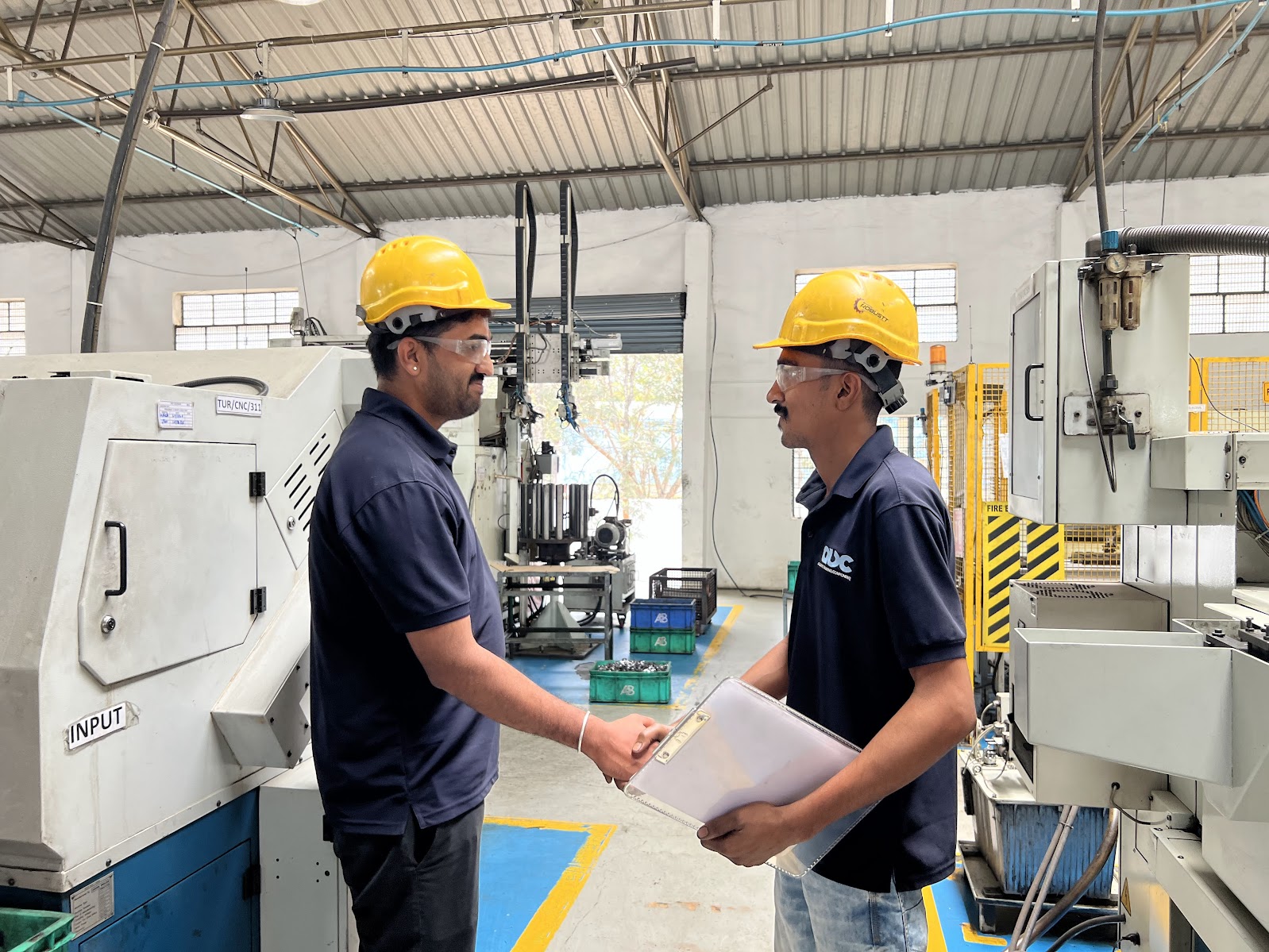
Ready to partner with a precision manufacturer you can trust?
Get a quote in 48 hours. PPAP-ready. IATF 16949 certified.